
We rely on courier services every day to send important documents, receive online orders, and keep supply chains moving. But have you ever wondered what actually happens between the moment you book a collection and the second a parcel lands on a doorstep?
This guide walks you through exactly how courier services work from the first booking click to the final delivery scan. Understanding the process helps businesses and individuals make smarter shipping decisions and get the most out of their courier partnerships.
What Is a Courier Service?
A courier service is a company that collects, transports, and delivers parcels, packages, documents, or goods on behalf of individuals and businesses. Unlike standard postal services, couriers typically offer faster delivery times, end-to-end tracking, and a higher level of accountability for each shipment.
Courier services can operate locally, nationally, or internationally and they cater to everything from a single envelope to large commercial freight. The defining features of a professional courier service include:
- Speed — faster than standard mail, often with same-day or next-day options.
- Tracking — real-time visibility into where your parcel is at every stage.
- Reliability — defined service level agreements and delivery guarantees.
- Security — insured transit and professional handling of goods.
The Courier Process: Step by Step
While every courier company operates slightly differently, the core process follows a clear and logical flow. Here is how it typically works:
Step 1: Booking and Scheduling
Everything begins when a customer places a booking. This can be done online through a courier platform, via a mobile app, by phone, or through an integrated API if you are a business using e-commerce software.
At this stage, the customer provides key details:
- Collection and delivery addresses.
- Parcel dimensions and weight.
- Service type (same-day, next-day, economy, etc.).
- Any special handling instructions.
The system calculates the cost based on these details, and once confirmed, a booking reference and label are generated.
Step 2: Collection
A courier driver is dispatched to collect the parcel from the sender’s address at the agreed time window. At collection, the driver scans the parcel’s barcode label, logging it into the courier’s tracking system. This is the first point of entry into the chain of custody.
For businesses with high volumes, couriers may arrange scheduled daily collections to streamline operations. Drop-off points and locker hubs are also increasingly common alternatives to home collection.
Step 3: Sorting and Processing at the Depot
Once collected, parcels are transported to a local depot or sorting hub. Here, sophisticated conveyor systems and barcode scanners sort thousands of packages according to their destination.
Modern sorting centres use automated technology to group parcels into delivery routes and load them onto the appropriate outbound vehicles. This process happens rapidly — often overnight — so that parcels can be on their way to the recipient the following morning.
For international shipments, this stage also involves customs documentation and compliance checks before the parcel is cleared for cross-border movement.
Step 4: Transit and Line Haul
For longer distances, parcels travel between regional hubs on what is known as the “line haul” — large vehicles, typically lorries or vans, that move bulk shipments between sorting centres across the country or internationally.
At each hub, parcels are scanned again, updating the tracking record. This is why customers often see multiple location updates when tracking a parcel — each scan represents a handover between stages of the journey.
Step 5: Local Delivery Routing
Once a parcel arrives at the depot closest to its destination, it is assigned to a delivery driver and loaded onto a delivery round. Route optimisation software calculates the most efficient order of stops, helping drivers complete their rounds quickly and reducing fuel consumption.
Many couriers now send automated notifications to recipients at this stage — an estimated delivery window, a live map of the driver’s progress, or a one-hour time slot — giving customers confidence about when to expect their parcel.
Step 6: Delivery and Proof of Delivery
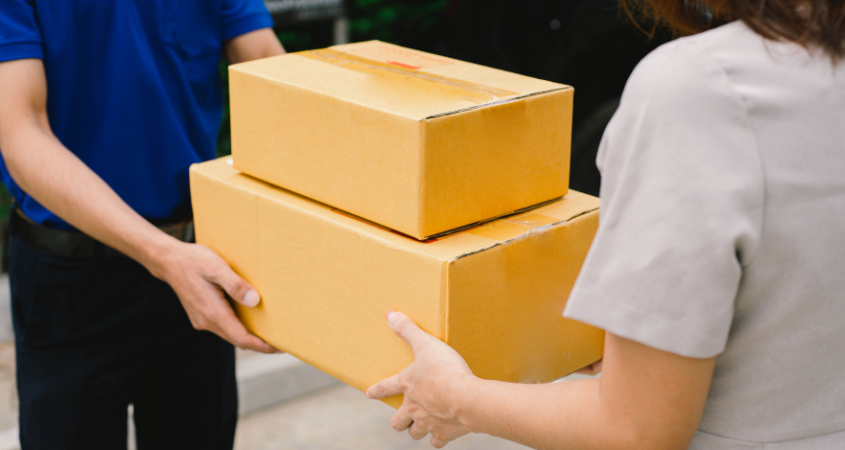
The final step is delivery to the recipient. The driver scans the parcel upon delivery, capturing a digital proof of delivery (POD) — usually a photograph, a signature, or both. This creates a permanent record confirming the parcel was delivered successfully.
If no one is available to receive the parcel, the courier will typically follow a pre-agreed safe-place instruction, leave a calling card, attempt a neighbour delivery, or return the parcel to the depot for a re-delivery attempt or collection.
Types of Courier Services
Not all courier services are the same. Different service types are designed to meet different needs:
- Same-Day Courier: Collection and delivery within hours — ideal for urgent documents or time-sensitive business shipments.
- Next-Day Courier: Collected today, delivered by the following business day. The most popular choice for e-commerce.
- Economy/Standard Service: A slower, more affordable option for non-urgent shipments, typically delivering within 2-5 working days.
- International Courier: Cross-border deliveries managed with customs clearance and global carrier networks.
- Specialist Courier: Tailored services for fragile items, temperature-sensitive goods, hazardous materials, or high-value shipments.
The Role of Tracking Technology
One of the defining features of a modern courier service is real-time tracking. From the moment a parcel is collected, every scan generates a timestamp and location update that is fed into the courier’s system — and made visible to the customer.
Tracking technology benefits both senders and recipients:
- Senders can confirm collection has taken place and monitor progress.
- Recipients receive accurate ETAs and delivery notifications.
- Businesses can use tracking data to identify delays and optimise their logistics.
- Customer service teams can quickly resolve queries using live parcel status information.
The best courier services offer full end-to-end visibility with proactive notifications at every key milestone.
What Makes a Great Courier Service?
Now that you understand how courier services work, how do you choose the right one? Here are the qualities that separate a good courier from a great one:
- Reliability: Consistent on-time delivery rates and minimal failed delivery attempts.
- Transparency: Clear pricing with no hidden surcharges, and honest communication when delays occur.
- Technology: An intuitive booking platform, real-time tracking, and API integration for business users.
- Customer Support: Accessible, responsive support when things go wrong — because sometimes they do.
- Scalability: The ability to handle your volume today and grow with you tomorrow.
- Care: Treating every parcel — whether it is a single envelope or a pallet of goods — with professionalism.
Conclusion
Courier services are far more than a vehicle and a driver. They are sophisticated logistical operations underpinned by technology, process, and people all working together to move your parcel safely and swiftly from A to B.
Whether you are an individual sending a one-off parcel or a business shipping hundreds of orders a day, understanding how the process works puts you in a stronger position to choose the right service and set your deliveries up for success.
At Aansaea, we are committed to making the courier process as simple, transparent, and efficient as possible. Get in touch today to find out how we can help you ship smarter.